Physical Address
304 North Cardinal St.
Dorchester Center, MA 02124
Physical Address
304 North Cardinal St.
Dorchester Center, MA 02124

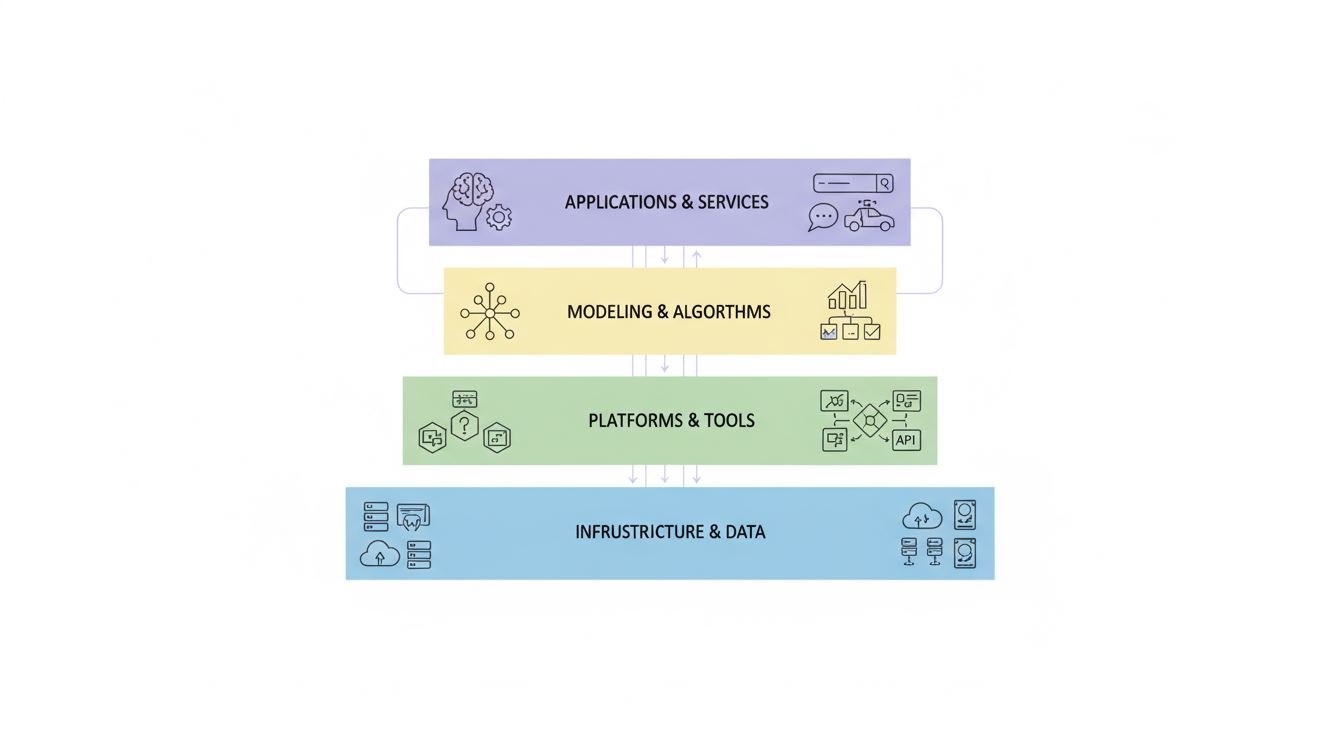
In the whirlwind world of artificial intelligence, the term “AI stack” pops up often, but what does it really mean? Think of it like assembling a complex machine—each part must fit perfectly for the whole system to hum smoothly. The modern AI stack is this layered architecture of tools, frameworks, and infrastructure working in harmony to develop, deploy, and maintain AI systems.
From the low-level hardware to the user-facing applications, the AI stack covers everything in-between. It’s the behind-the-scenes ecosystem that powers everything from chatbots on your phone to recommendation engines guiding your next movie night.
At the base, there’s the hardware—physical machines like GPUs, TPUs, and increasingly, specialized AI chips. These aren’t just your run-of-the-mill processors; they’re tailored to handle the intense computations neural networks demand.
Why does this matter? Because training sophisticated AI models involves crunching massive datasets and millions of parameters. Without the right hardware, this feat becomes impractical or slow.
Next up are the frameworks and libraries—the programming toolkits that make creating AI models feasible. Think TensorFlow, PyTorch, or JAX. They provide high-level APIs that abstract away complex math and allow developers to build models somewhat like how a carpenter uses power tools rather than chisels alone.
These frameworks have evolved to support everything from classical machine learning algorithms to cutting-edge deep learning networks, making them the cornerstone of AI development.
AI is only as good as the data it learns from. Enter data platforms and pipelines, responsible for collecting, cleaning, and feeding data to algorithms. If you’ve ever dealt with messy spreadsheets or missing entries, you know how critical this step can be.
Modern AI stacks integrate data engineering tools to automate these workflows, ensuring models have reliable, high-quality data. Areas like feature stores and data versioning are gaining prominence here, especially for reproducibility and governance.
Training an AI model is a resource-intensive process. This layer involves tools and services that manage the training workflow, scale resources dynamically, and handle things like hyperparameter tuning.
Solutions like Kubernetes for orchestration or cloud platforms offering managed AI services simplify what once required deep infrastructure expertise. To the untrained eye, the whole process of scheduling jobs, managing checkpoints, and monitoring performance might seem invisible, but it’s central to ensuring a model learns well.
After the model is trained, it needs to be deployed so users can interact with it. This layer handles how AI predictions happen in real time or batch environments.
Whether it’s voice assistants interpreting our commands or fraud detection algorithms scanning transactions, fast and reliable inference is crucial. Technologies like model compression, edge computing, or serverless deployment help bring AI closer to users with minimal latency.
AI isn’t a “set it and forget it” system. Continuous monitoring ensures models perform as expected over time. If data drifts or models degrade, the stack includes tools for retraining and updating.
Governance frameworks and explainability tools help maintain ethical AI usage and compliance, increasingly important as AI integrates deeper into sensitive areas.
Understanding the AI stack isn’t just for engineers. It helps businesses and decision-makers grasp what’s feasible and how to invest wisely. For example, knowing whether to prioritize faster hardware upgrades or invest in better data pipelines can impact project outcomes tremendously.
The stack also reveals why AI projects sometimes falter. Without a solid data foundation or proper monitoring, even the fanciest models can fail in production.
Take autonomous vehicles. The AI stack here is a marvel, integrating sensor hardware, real-time data processing pipelines, deep learning frameworks for perception, and rapid inference systems that make split-second driving decisions.
Or consider personalized healthcare recommendations. The stack involves secure, compliant data handling, model training on diverse patient data, deployment in clinician tools, and stringent governance to protect privacy.
One frequent misconception is that AI frameworks alone solve the problem. In reality, ignoring data quality, infrastructure scalability, or deployment nuances can doom projects from the start.
Another pitfall is underestimating the operational complexity. Deploying a model is where theory meets messy reality—latency issues, unexpected edge cases, or compliance hurdles often emerge.
A third challenge is viewing the AI stack as static rather than evolving. The field moves rapidly, and keeping pace means adopting new tools, retraining models with fresh data, and iterating on workflows continuously.
As AI capabilities expand, the stack itself is becoming more modular and accessible. Low-code platforms, AutoML tools, and edge AI chips are democratizing AI development beyond traditional experts.
Moreover, ethical AI and sustainability concerns are pushing the stack to incorporate transparency and energy-efficient design more robustly.
In essence, the modern AI stack is not just a technical blueprint—it’s an ecosystem balancing innovation, usability, and responsibility.
The modern AI stack is the backbone of contemporary AI applications, weaving together hardware, software, data, and processes into a coherent whole. Appreciating its layers helps demystify how AI systems come to life and why each component is vital.
Whether you’re a developer, a business leader, or simply an enthusiast, understanding this architecture provides a clearer window into AI’s potential and pitfalls. Like any sophisticated machine, the beauty of AI lies not just in its parts, but in how they dance together.