Physical Address
304 North Cardinal St.
Dorchester Center, MA 02124
Physical Address
304 North Cardinal St.
Dorchester Center, MA 02124

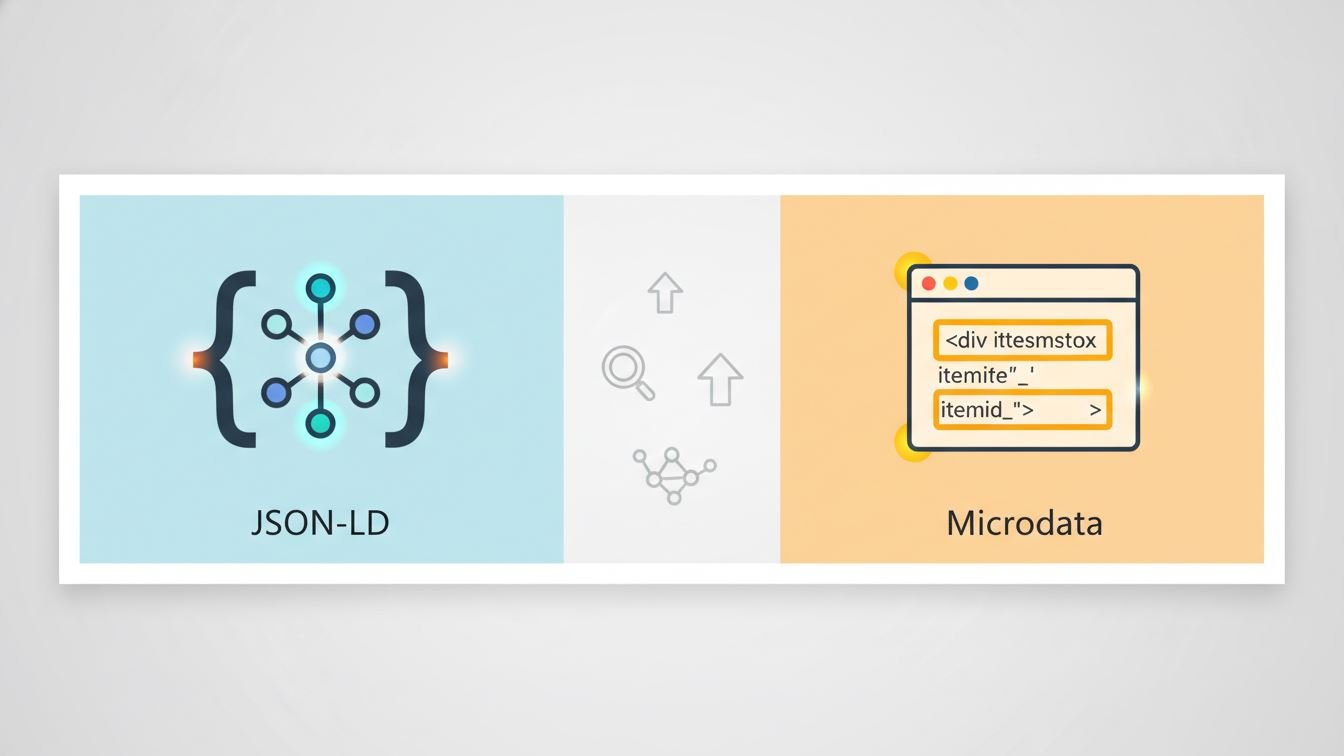
If you’re diving into the world of SEO and rich snippets, you’ve probably encountered structured data. Two popular ways to add structured data to web pages are JSON-LD and Microdata. Each has its quirks, benefits, and ideal use cases, and choosing between them isn’t always straightforward.
Let’s demystify what these formats are, how they differ, and when you might favor one over the other.
Structured data is a standardized format used to annotate content on the web, helping search engines better understand what your pages are about. Think of it as adding context or “labels” to your content so that Google, Bing, and others can serve up more informative, visually enhanced results—like star ratings in reviews, event dates, or recipe instructions.
Both JSON-LD and Microdata are formats that adhere to schema.org vocabularies, which provide definitions for various page elements and their properties.
Microdata was introduced earlier and involves embedding metadata directly into the HTML elements. You add specific attributes—like itemscope and itemprop—right inside your tags to define the items and their properties.
Here’s a quick example: imagine marking up a product name and price inside a product page.
<div itemscope itemtype="https://schema.org/Product"><span itemprop="name">Wireless Headphones</span><span itemprop="price">$99</span></div>This approach tightly couples the structured data with the visible page content, which some find intuitive since the data “lives” alongside the user-facing elements.
JSON-LD (JavaScript Object Notation for Linked Data) takes a different tack. Instead of sprinkling tags throughout your HTML, it lets you place a block of JSON code—inside a script tag in the head or body of your page—that describes the structured data.
This separation can be a big advantage, as the structured data remains clear, easy to read, and easier to manage or update independently of your page’s content markup.
For example, the same product would look like this in JSON-LD:
<script type="application/ld+json">{ "@context": "https://schema.org/", "@type": "Product", "name": "Wireless Headphones", "price": "99"}</script>Microdata is parsed inline by search engines as they crawl through the HTML. This means search engines extract metadata directly as they process page elements. On the other hand, JSON-LD is parsed from the script block, allowing search engines to read structured data without having to traverse multiple nodes in the DOM.
This is more than a technicality: JSON-LD often avoids issues where markup gets broken or misinterpreted because it’s not tangled with the visual HTML structure.
Over recent years, Google has strongly endorsed JSON-LD as the preferred method for implementing structured data. It’s generally cleaner, less prone to human error, and easier to maintain, particularly for dynamic sites where you might generate structured data programmatically.
Because JSON-LD is separate, developers can update metadata without touching the page layout or worrying about breaking other HTML elements—a big plus in large or content-rich environments.
Some legacy systems and CMS platforms still produce Microdata by default. Also, when you want your structured data tightly coupled with specific elements—for example, highlighting multiple items on the same page with distinct structured data—Microdata’s inline approach can help keep everything structured neatly in context.
It’s also useful if you’re working with older crawlers or tools that haven’t fully embraced JSON-LD yet, though these situations are becoming rare.
One common misunderstanding is that you can just sprinkle both JSON-LD and Microdata on the same page without issues. In reality, this can confuse crawlers and dilute the effectiveness of your markup. It’s usually best to choose one format per page to maintain clarity.
Another trap: incorrectly nesting or missing essential properties. For example, forgetting to declare @context in JSON-LD or neglecting itemscope in Microdata can make your structured data invisible to search engines.
If you own an e-commerce site, applying structured data means your products could show up with rich snippets—star ratings, prices, stock availability—that draw more clicks. JSON-LD is excellent here because you can update prices or availability dynamically without touching the visible HTML.
For articles or blogs, JSON-LD lets you embed author info, publishing dates, and keywords neatly, which improves your chances for enhanced search results like Top Stories or rich cards.
Meanwhile, Microdata could be handy in microsites or landing pages where you want your structured data visibly tied to the content elements, making it easier for teams unfamiliar with JSON to manage.
So, what should you choose? Simply put, JSON-LD is generally the better bet for modern SEO work. It’s cleaner, favored by Google, and easier to keep up to date.
However, if you’re maintaining a legacy website or have very specific inline needs, Microdata can still do the job effectively.
Ultimately, the goal is clear, consistent, and valid structured data—you want search engines to understand your content without confusion.
Structured data isn’t just about pleasing search engines; it’s about improving how your content is discovered and presented. JSON-LD’s rise reflects an industry-wide shift toward cleaner, more adaptable data integration strategies.
While Microdata laid the groundwork, JSON-LD now leads as the go-to standard. Embracing JSON-LD allows you to future-proof your SEO efforts, making your content more engaging in search results with less hassle.
Whichever format you choose, the key is to implement it thoughtfully, validate it regularly (using tools like Google’s Rich Results Test), and keep your data accurate and up to date. That’s how you truly unlock the power of structured data.